
Designers / Publisher / Year: Richard Garfield / IELLO / 2011
Player Count / Playtime: 2-6 Players / 30 mins
Genre / Type / Mechanics: Fighting, Dice Rolling, Push-Your-Luck, King of the Hill, Player Elimination
King of Tokyo throws giant monsters into a chaotic battle for fame, destruction, and survival, all powered by chunky dice rolls and a healthy dose of push-your-luck tension. Each player controls a monster trying to either reach 20 victory points or become the last creature standing after everyone else has been knocked out. On your turn, you roll six dice up to three times Yahtzee-style, deciding whether to chase points, heal, gain energy cubes, or attack the monsters occupying Tokyo. Energy cubes can then be spent on power cards that grant permanent upgrades or one-time effects, giving each game a little asymmetry and unpredictability.
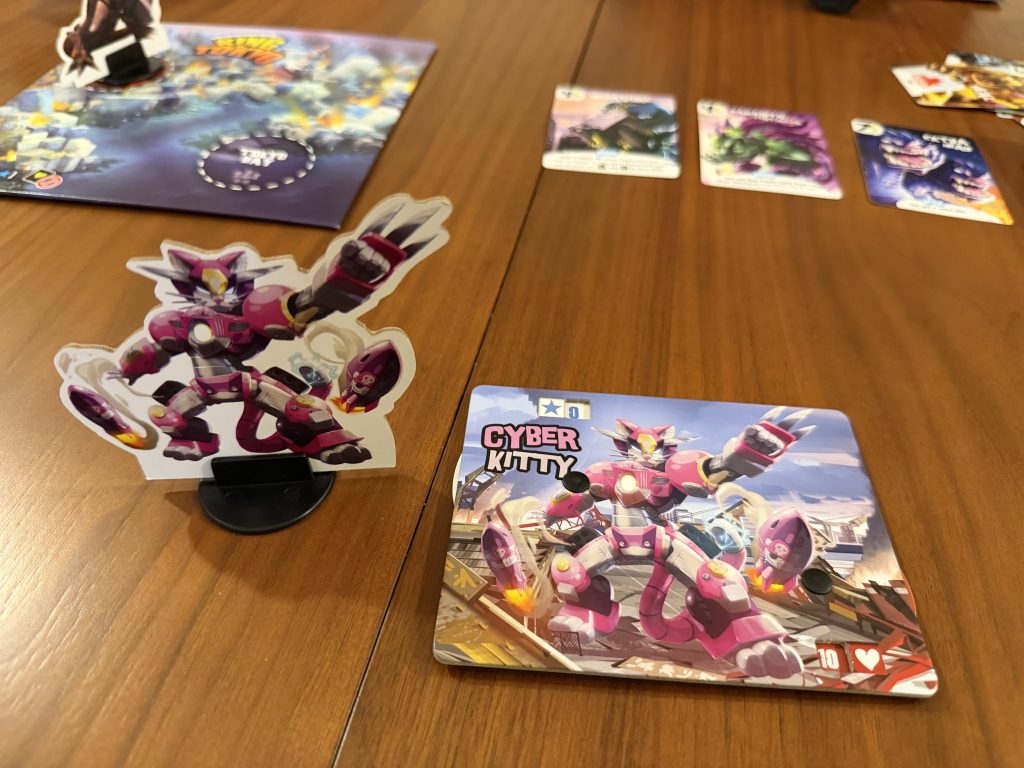
What makes King of Tokyo work is how approachable and energetic it feels. The game is extremely easy to teach, which makes it a reliable option for casual groups, party nights, or introducing newer players to hobby games. The player interaction is constant, especially once Tokyo becomes contested territory and everyone starts weighing whether staying in the city is worth the damage. The dice rolling is satisfying, the push-your-luck decisions are fun, and the oversized monster components and artwork give the game a playful personality that helps it stand out on the table.

The power cards are probably my favorite part of the design. Some create ridiculous combos, others completely shift strategy, and they help keep games from feeling too repetitive. Even when the core gameplay is simple, the cards inject enough variety and chaos to create memorable moments.
That said, I’ve always felt the win conditions are a little uneven. In theory, you can win by reaching 20 victory points or by eliminating the other players, but in practice I rarely see anyone actually win through points. Most games simply turn into a battle of attrition where one monster survives while everyone else gets knocked out. Because of that, the scoring path can sometimes feel secondary instead of equally viable.
I’m also not a huge fan of player elimination here. In higher player-count games especially, getting eliminated early can leave someone sitting around for quite a while waiting for the game to finish. Since the game is built around fast, lively interaction, losing that engagement can hurt the overall experience for the eliminated player.
Even with those issues, King of Tokyo is still a perfectly solid game night choice. It is quick to learn, easy to get to the table, and creates plenty of loud, chaotic moments that casual groups tend to enjoy. I like it, and I understand why it remains popular, but it is not usually the game I personally reach for first when deciding what to play.
Verdict: King of Tokyo is a fun, fast, and approachable dice-chucking monster brawler that works best as a light party-style game. The constant player interaction, push-your-luck gameplay, and entertaining power cards make it easy to enjoy, especially with casual groups or newer players. However, the uneven win conditions and player elimination keep it from being a game I actively seek out. Most sessions end with simple survival rather than clever point play, and eliminated players can spend too long watching from the sidelines. Still, for a loud, quick, easy-to-teach game night experience, King of Tokyo absolutely delivers.
Reviewed on 05/26/2026
Score Breakdown
| Category | Description | Score (1–10) |
|---|---|---|
| 1. Aesthetics & Components | Visual design, artwork, tactile quality, and overall presentation. | 8 |
| 2. Rules Clarity & Accessibility | Ease of learning, clarity of rulebook, setup time, and iconography. | 8 |
| 3. Strategic Depth | Amount of meaningful decision-making and long-term planning. | 5 |
| 4. Luck vs. Skill Balance | How fairly chance and skill coexist. | 4 |
| 5. Player Interaction | Engagement and social dynamics between players. | 8 |
| 6. Pacing & Downtime | Flow, engagement, and smoothness of play. | 8 |
| 7. Replayability | Longevity, variability, and continued appeal. | 6 |
| 8. Theme Integration | How well the mechanics and story fit the theme. | 6 |
| 9. Enjoyment & Emotional Impact | Pure fun factor—excitement, tension, satisfaction. | 6.5 |
| 10. Innovation & Uniqueness | Creativity, originality, and distinctiveness from other games. | 5 |
| Overall Mean Score | 6.45 / 10 | |