
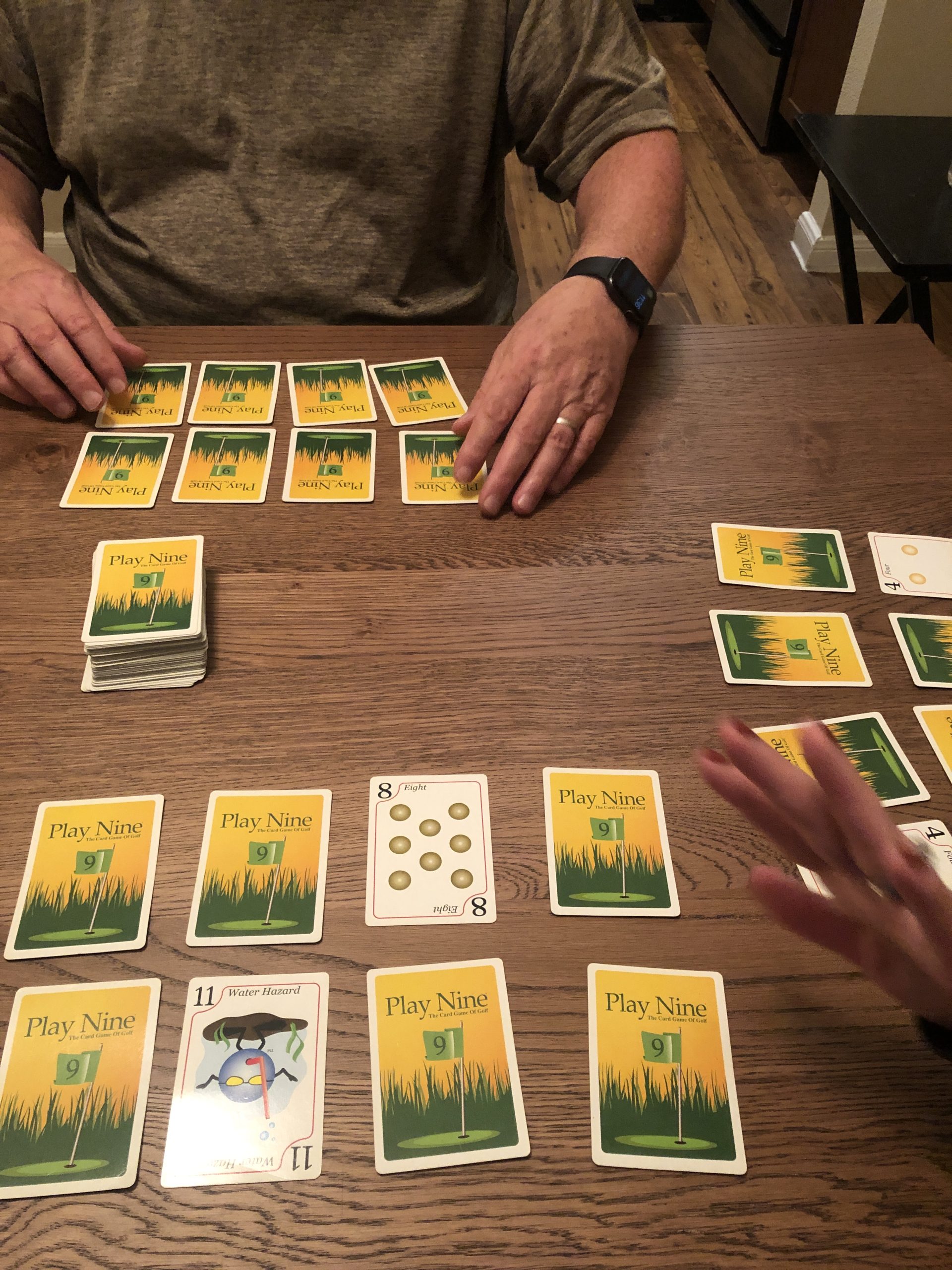
Designers / Publisher / Year: Ceil Anderson, Kathy Assell / Double A Productions / 2004
Player Count / Playtime: 2-6 Players / 45 mins
Genre / Type / Mechanics: Card Game, Set Collection, Hand Management, Golf
Play Nine is one of those deceptively simple card games that becomes more satisfying the more you play it. At first glance, it feels like a lightweight golf-themed family game, but there are a few genuinely brilliant scoring ideas hidden inside the design that make every round exciting.
In Play Nine, players are trying to finish nine rounds, or “holes”, with the lowest total score possible. Each player starts with a grid of face-down cards and gradually reveals, replaces, and swaps cards throughout the round while trying to lower their score. The core strategy comes from deciding when to keep low-value cards, when to gamble on unknown cards, and when to complete matching columns that cancel points entirely. Much like golf itself, the goal is not to score big, but to finish with as few points as possible by the end of the game.
The smartest mechanic in the game is the matching top-and-bottom column system. Watching two matching cards in the same column completely cancel each other out already feels great, but the game takes it even further. If you manage to create two matching columns of the same number, four matching cards total, not only do they all cancel out, but you also earn an additional bonus deduction from your score.
And then there are the legendary Hole-in-One cards. Pulling a -5 already feels amazing, but if you can somehow collect all four -5 cards (which I have seen), the game rewards you with an even bigger bonus on top of the already incredible score reduction. It is one of those moments that instantly becomes the highlight of the round and usually sends the whole table into disbelief.
That is what makes Play Nine so enjoyable to me. The game constantly creates little moments of excitement through combinations and scoring synergies. You are never just lowering points, you are chasing satisfying setups and hoping the perfect card appears at exactly the right time.
As someone who loves golf, the theme naturally works for me. The low-score mentality and the nine-round structure capture the feeling of golf surprisingly well without becoming overly thematic or complicated. But honestly, you do not need to care about golf at all to enjoy the game. The mechanics are clever enough to stand entirely on their own.
What I appreciate most about Play Nine is how approachable it is. The rules are easy to teach, rounds move quickly, and almost everyone immediately understands the thrill of flipping over a perfect card or completing a huge combo. It is portable, replayable, and full of those tiny dopamine-hit moments that keep people asking for another round.
Verdict: Play Nine is a lightweight card game built around a few genuinely genius scoring mechanics. The matching-column system and massive bonus combinations create exciting moments that feel far more rewarding than the game’s simple rules would suggest. Whether you are a golfer or not, Play Nine delivers the kind of casual, addictive fun that is incredibly easy to bring back to the table. Highly reccomend for any collection.
Reviewed on 05/12/2026
Score Breakdown
| Category | Description | Score (1–10) |
|---|---|---|
| 1. Aesthetics & Components | Visual design, artwork, tactile quality, and overall presentation. | 7 |
| 2. Rules Clarity & Accessibility | Ease of learning, clarity of rulebook, setup time, and iconography. | 8 |
| 3. Strategic Depth | Amount of meaningful decision-making and long-term planning. | 5.5 |
| 4. Luck vs. Skill Balance | How fairly chance and skill coexist. | 5 |
| 5. Player Interaction | Engagement and social dynamics between players. | 7 |
| 6. Pacing & Downtime | Flow, engagement, and smoothness of play. | 8 |
| 7. Replayability | Longevity, variability, and continued appeal. | 8 |
| 8. Theme Integration | How well the mechanics and story fit the theme. | 7 |
| 9. Enjoyment & Emotional Impact | Pure fun factor—excitement, tension, satisfaction. | 7.5 |
| 10. Innovation & Uniqueness | Creativity, originality, and distinctiveness from other games. | 7 |
| Overall Mean Score | 7 / 10 | |