Designers / Publisher / Year: Jamey Stegmaier / Stonemaier Games / 2016
Player Count / Playtime: 1-5 Players / 120 mins
Genre / Type / Mechanics: Engine Building, Economic, Fighting, Area Influence, Grid Movement, Territory Building, Science Fiction
Expansions: Scythe: Invaders from Afar (2016), The Wind Gambit (2017), The Rise of Fenris (2018), Encounters (2018), Modular Board (2019)
Set in an alternate-history 1920s Europe recovering from a devastating war, Scythe presents a dark and fascinating world where massive dieselpunk mechs roam across farmland, forests, rivers, and industrial territories. From the moment the game hits the table, it immediately creates a sense of scale and atmosphere that few modern board games can match.

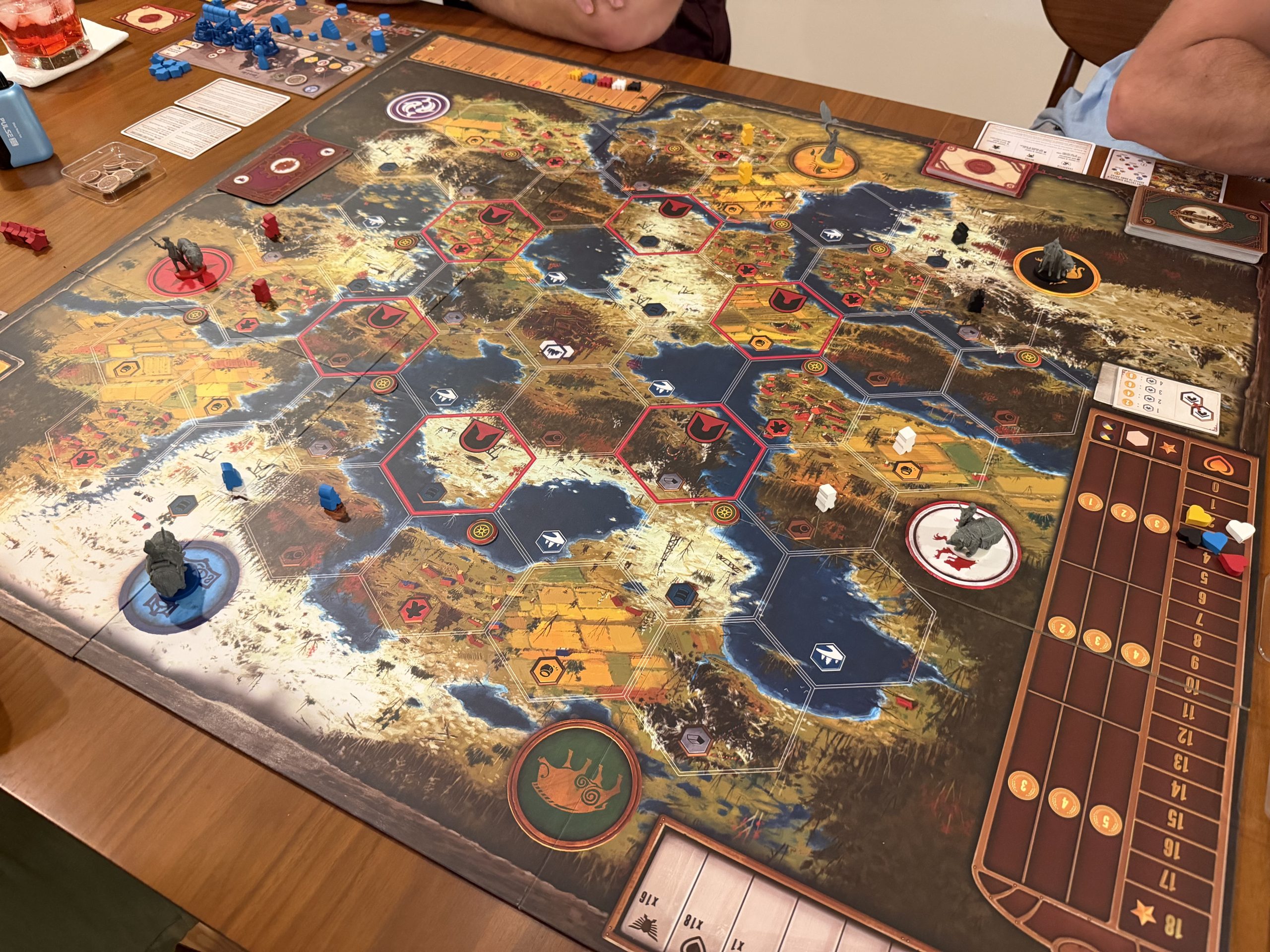
One of the biggest strengths of Scythe is simply its presentation. The artwork is phenomenal throughout the entire experience, giving the world a gritty, mysterious, almost melancholic tone that perfectly supports the theme. The oversized modular board is absolutely worth it and feels almost essential for fully appreciating the scale of the game. Watching factions slowly expand across the massive map while giant mechs emerge onto the battlefield creates an incredible table presence.
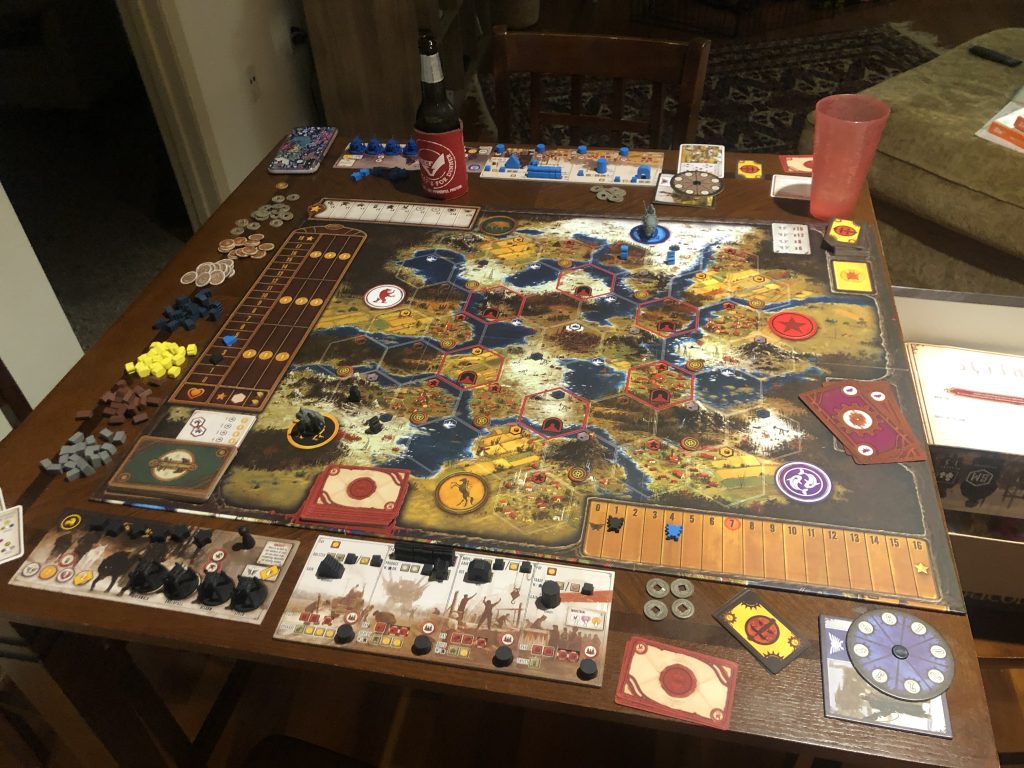
The components themselves are equally impressive. The mech miniatures are fantastic and instantly recognizable, helping each faction feel unique and powerful. Combined with the upgraded resources, player mats, and detailed faction boards, Scythe consistently feels like a premium production. Every movement and action feels satisfying because the physical presentation is so strong.

Mechanically, Scythe occupies a really nice middle ground between accessibility and depth. It is definitely a mid-weight strategy game rather than an overly heavy Euro, but it still offers plenty of meaningful decisions and long-term planning. The action selection system is one of the best aspects of the design, forcing players to think carefully about efficiency, timing, and engine building without becoming overly complicated. Once the gameplay flow clicks, turns move fairly naturally, but there is still a learning curve during the first play or two as players understand how the systems connect together.

Another standout feature is the encounter card system. These cards feel almost like small RPG events scattered across the map, offering players thematic choices that help bring the world to life. Rather than simply selecting mechanical bonuses, players are making narrative decisions that add personality and immersion to the game. Those moments help Scythe feel more alive than many traditional Euro-style strategy games.
Despite the presence of giant mechs and military factions, Scythe is not purely a combat-focused game. Instead, combat serves more as tension and deterrence while the real focus remains on territory control, resource management, economic growth, and efficient expansion. This creates an interesting balance where players constantly feel threatened without the game devolving into nonstop fighting. The result is a strategic experience that rewards smart positioning and planning more than brute force aggression.
The game also scales very well across different player counts. It works especially well with 2, 3, or 4 players, where the map has enough room for development while still maintaining tension and interaction. Every faction feels distinct, and experimenting with different faction and player mat combinations gives the game excellent replayability.
What ultimately makes Scythe so memorable is how cohesive everything feels together. The dark science-fiction setting, the towering mechs, the economic engine building, the territorial expansion, and the atmospheric artwork all blend into a unified experience that feels both immersive and rewarding. Few games manage to feel this cinematic while still maintaining strong strategic gameplay underneath.
Verdict: Scythe is an outstanding strategy game that combines incredible production quality, immersive worldbuilding, and elegant mid-weight gameplay into one of the most memorable modern board game experiences available. The oversized modular board, detailed mech miniatures, stunning artwork, and highly satisfying engine-building systems make every session feel epic without becoming overly difficult to learn. While the first game may require some patience as players understand the systems, the experience becomes incredibly smooth and rewarding once everything clicks. Whether played competitively or casually, Scythe consistently delivers a tense, atmospheric, and deeply enjoyable experience that fully earns its reputation as a modern classic.
Reviewed on 05/09/2026
Score Breakdown
| Category | Description | Score (1–10) |
|---|---|---|
| 1. Aesthetics & Components | Visual design, artwork, tactile quality, and overall presentation. | 10 |
| 2. Rules Clarity & Accessibility | Ease of learning, clarity of rulebook, setup time, and iconography. | 7 |
| 3. Strategic Depth | Amount of meaningful decision-making and long-term planning. | 9 |
| 4. Luck vs. Skill Balance | How fairly chance and skill coexist. | 9 |
| 5. Player Interaction | Engagement and social dynamics between players. | 9 |
| 6. Pacing & Downtime | Flow, engagement, and smoothness of play. | 6.5 |
| 7. Replayability | Longevity, variability, and continued appeal. | 8 |
| 8. Theme Integration | How well the mechanics and story fit the theme. | 9 |
| 9. Enjoyment & Emotional Impact | Pure fun factor—excitement, tension, satisfaction. | 9 |
| 10. Innovation & Uniqueness | Creativity, originality, and distinctiveness from other games. | 8 |
| Overall Mean Score | 8.45 / 10 | |