Designers / Publisher / Year: Randy Flynn / Flatout Games / 2021
Player Count / Playtime: 1-4 Players / 30-45 mins
Genre / Type / Mechanics: Pattern Building, Open Drafting, Hexagon Grid, Animals, Environmental, Family, Abstract
Reminds Me Of: Harmonies
Ever since Cascadia was released, it has become one of the defining tile-laying games of the genre. Harmonies arrived a few years later, and it’s impossible not to compare the two. Even though Cascadia came first, I actually played Harmonies before I ever tried Cascadia, so that’s naturally the perspective I’m coming from. If you’d like to see my thoughts on it, you can also check out my review of Harmonies.

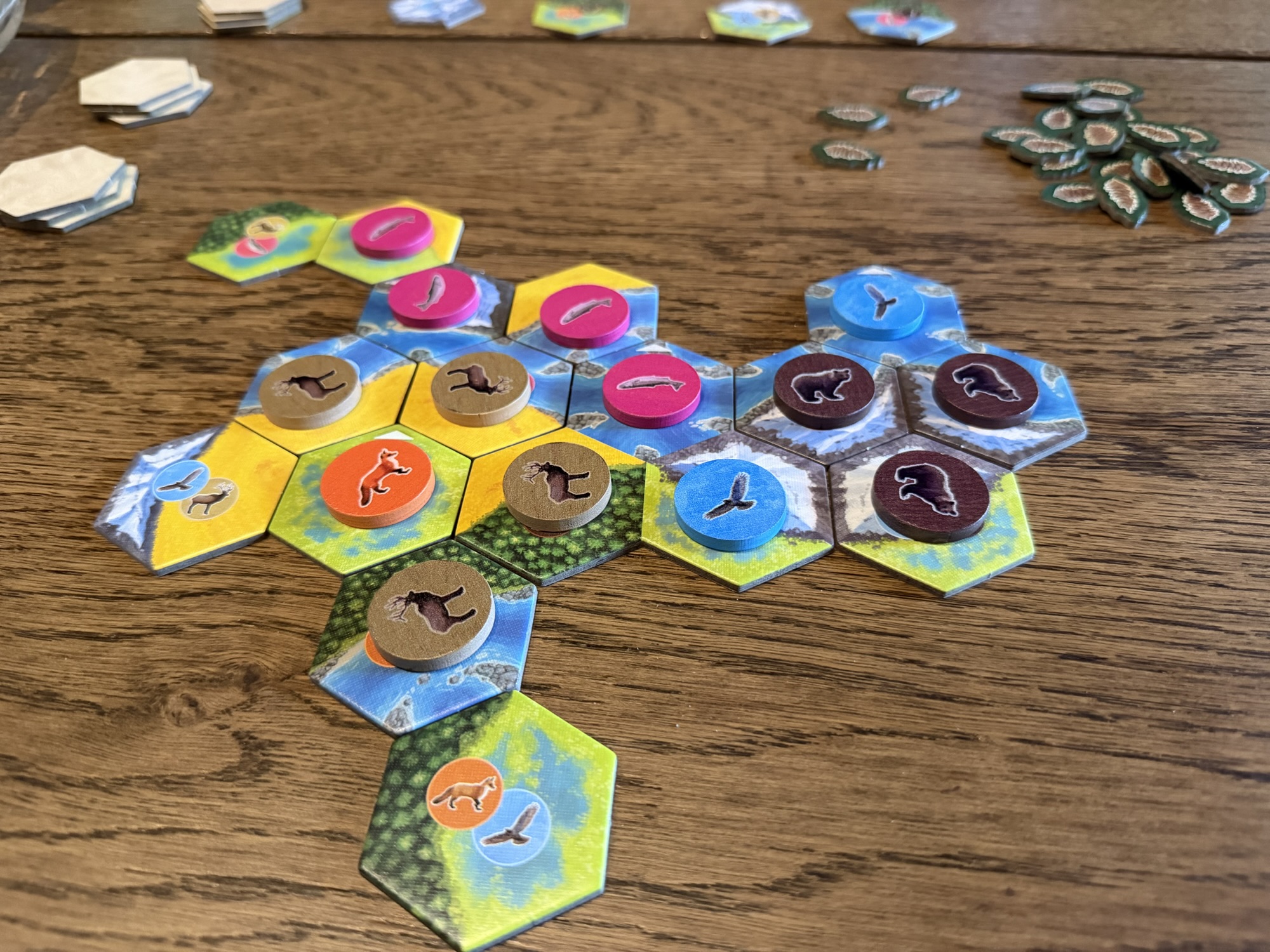
In Cascadia, players take turns drafting a pair consisting of a habitat tile and a wildlife token. The habitat tile is added to your growing landscape while the wildlife token is placed on an appropriate tile to score points based on species-specific objectives. Throughout the game, you’re constantly balancing two goals: building large, connected habitat regions while arranging your bears, elk, salmon, hawks, and foxes into valuable scoring patterns. Every draft presents an interesting dilemma, making each turn feel meaningful without becoming overwhelming.
One of Cascadia’s greatest strengths is its accessibility. The rules are incredibly easy to learn, but the game still offers plenty of satisfying decisions. It’s the kind of design that’s welcoming to new players while providing enough depth to keep experienced gamers coming back.
Although the gameplay shares similarities with Harmonies, I think the biggest difference is the atmosphere each game creates. Cascadia feels like you’re exploring the Pacific Northwest or hiking through the Canadian Rockies. The forests, rivers, mountains, and wildlife create a calm, natural setting that perfectly matches the relaxing gameplay. Harmonies, on the other hand, reminds me more of lush rainforests and African landscapes. The games may occupy a similar space mechanically, but they each have their own identity.
I also think Cascadia is the simpler game of the two. And I’ll say it, I personally enjoy Harmonies a little more. Whether that’s because it was my introduction to this style of game or because I genuinely prefer its puzzle is hard to say. That’s probably something that will come down to personal taste. What I can say is that owning one doesn’t replace the other. They coexist happily on our shelf because they each deliver a slightly different experience.
Perhaps the biggest compliment I can give Cascadia is that it continues to hit the table. My wife and I regularly choose between Cascadia and Harmonies when we’re looking for a relaxing two-player game. Both are beautiful, thoughtful, and consistently enjoyable, which is about as high a recommendation as I can give.
Verdict: Cascadia is an elegant, approachable tile-laying game that has earned its reputation as a modern must-try. It combines simple rules with meaningful decisions and creates a wonderfully relaxing experience from start to finish. I personally give a slight edge to Harmonies, but that’s more a reflection of my own taste than a criticism of Cascadia. If you enjoy peaceful strategy games that play exceptionally well with two players, Cascadia deserves a spot on your shelf.
Reviewed on 07/05/2026
Score Breakdown
| Category | Description | Score (1–10) |
|---|---|---|
| 1. Aesthetics & Components | Visual design, artwork, tactile quality, and overall presentation. | 7 |
| 2. Rules Clarity & Accessibility | Ease of learning, clarity of rulebook, setup time, and iconography. | 9 |
| 3. Strategic Depth | Amount of meaningful decision-making and long-term planning. | 6 |
| 4. Luck vs. Skill Balance | How fairly chance and skill coexist. | 6.5 |
| 5. Player Interaction | Engagement and social dynamics between players. | 4 |
| 6. Pacing & Downtime | Flow, engagement, and smoothness of play. | 9 |
| 7. Replayability | Longevity, variability, and continued appeal. | 7 |
| 8. Theme Integration | How well the mechanics and story fit the theme. | 7 |
| 9. Enjoyment & Emotional Impact | Pure fun factor—excitement, tension, satisfaction. | 7 |
| 10. Innovation & Uniqueness | Creativity, originality, and distinctiveness from other games. | 7 |
| Overall Mean Score | 6.95 / 10 | |