Designer / Publisher / Year: Uwe Rosenberg / Lookout Games / 2016
Player Count / Playtime: 1-4 Players / 30-120 mins
Genre / Type / Mechanics: Eurogame, Strategy, Farming, Economic, Animals, Worker Placement, Hand Management
Expansions: Agricola: Artifex Deck (2016), Agricola: Bubulcus Deck (2016), Agricola: Corbarius Deck (2017), Agricola: Dulcinaria Deck (2017), Agricola: Consul Dirigens Deck (2018), Agricola: Ephipparius Deck (2019), Agricola: Farmers of the Moor (2008), Agricola: 5 and 6 Players (2008)
Do you like the idea of living off the land? Farming crops? Growing vegetables? Raising livestock? Building a homestead? Starting a family? What about taking up carpentry or masonry? Or maybe being a mushroom collector is more your speed? Have you ever dreamt about churning your own butter? Or making your clothes from your own loom? If you answered yes to any of these questions, Agricola may be the game for you!

Agricola, in my opinion, is the crème de la crème of Eurogames. It requires a lot of forward planning, careful resource management, and strategic decision making. There is minimal luck, indirect competition, no player elimination, and short downtime between turns, which means the game can go by fast.

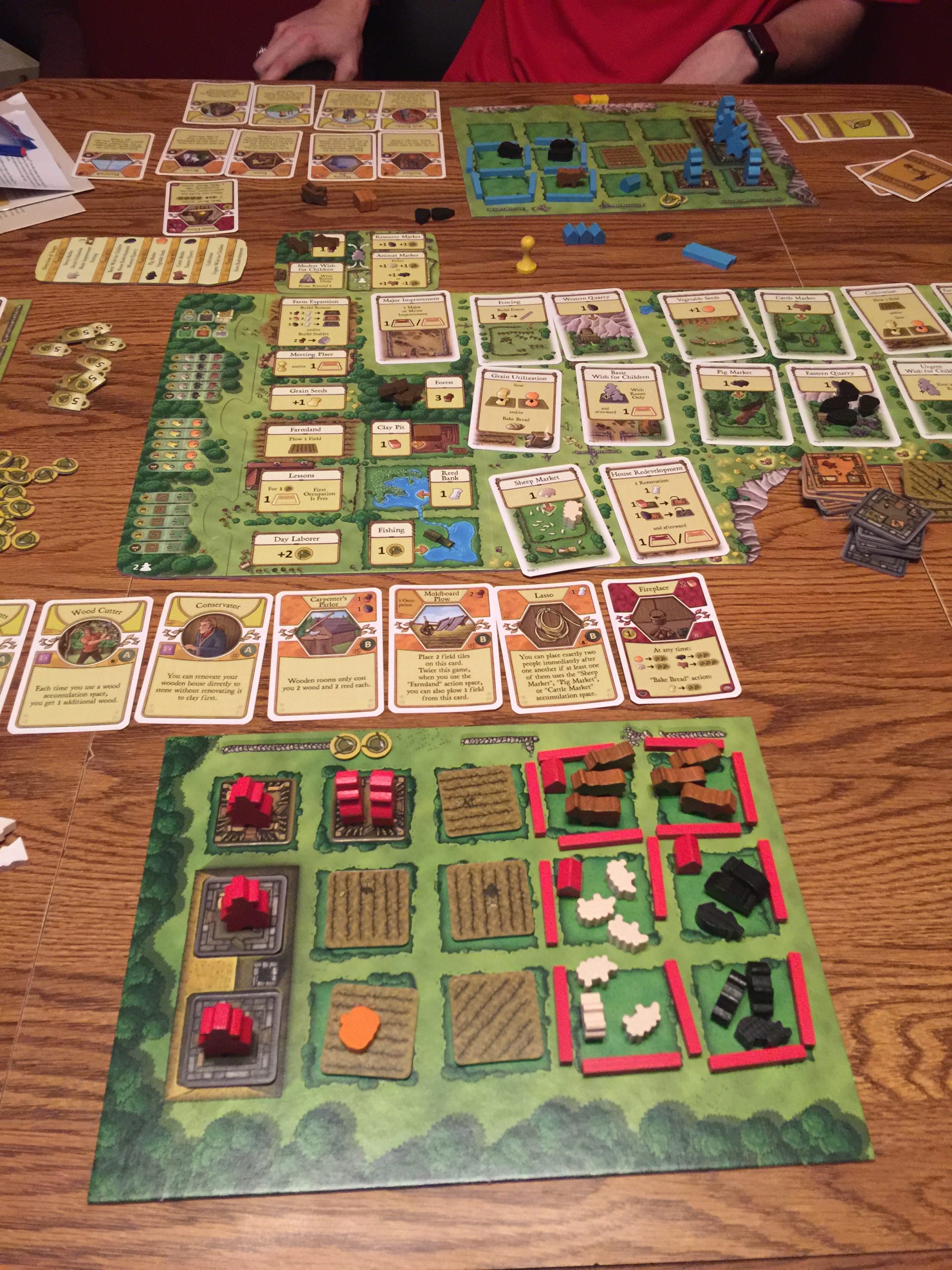
At its core, the game is a worker placement system. Each round, you place your family members on shared action spaces to gather resources like wood, clay, and food, or to expand your farm by building rooms, fences, and fields. The catch is that once a space is taken, it’s blocked for everyone else that round, so timing and turn order matter a lot. As the game progresses, more actions become available, giving you new ways to grow your farm, but also more decisions to juggle as time runs out.
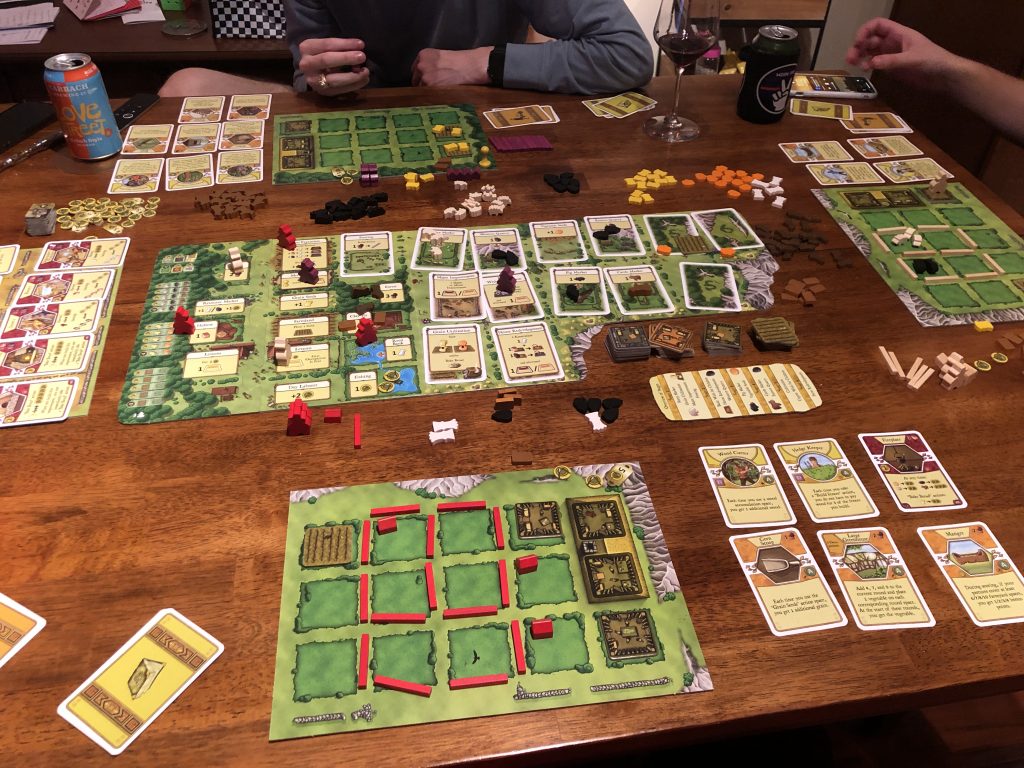
You’re constantly balancing growth with survival. Expanding your family gives you more actions each round, but it also means you need to produce more food to feed everyone during harvests. Planting crops, raising animals, and upgrading your house all contribute to your final score, but neglecting any one area can cost you the game.
At the end of a game of Agricola, I always find myself thinking the same thing: just two more turns, and my farm would have been perfect. There’s always one more improvement to build, one more field to plow, one more meal to prepare. And this is what always keeps me coming back.
Verdict: Peak Eurogame. Homey, approachable theme. Great components and meeples. One of my favorite games of all time. What else needs to be said?
Reviewed on 10/22/2025, updated 04/19/2026
Score Breakdown
| Category | Description | Score (1–10) |
|---|---|---|
| 1. Aesthetics & Components | Visual design, artwork, tactile quality, and overall presentation. | 8 |
| 2. Rules Clarity & Accessibility | Ease of learning, clarity of rulebook, setup time, and iconography. | 7 |
| 3. Strategic Depth | Amount of meaningful decision-making and long-term planning. | 10 |
| 4. Luck vs. Skill Balance | How fairly chance and skill coexist. | 9 |
| 5. Player Interaction | Engagement and social dynamics between players. | 4 |
| 6. Pacing & Downtime | Flow, engagement, and smoothness of play. | 8.5 |
| 7. Replayability | Longevity, variability, and continued appeal. | 8 |
| 8. Theme Integration | How well the mechanics and story fit the theme. | 8 |
| 9. Enjoyment & Emotional Impact | Pure fun factor—excitement, tension, satisfaction. | 9 |
| 10. Innovation & Uniqueness | Creativity, originality, and distinctiveness from other games. | 8.5 |
| Overall Mean Score | 8 / 10 | |