
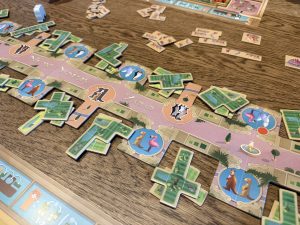
New York Zoo is a light strategy board game where players are building their own zoo by fitting oddly shaped enclosure tiles into a personal board. Essentially, you’re solving a puzzle while managing animal enclosures at the same time. On your turn, you’re typically choosing between taking a new enclosure tile to expand your zoo or adding animals to the enclosures you’ve already placed. As your zoo grows, space becomes tighter, and every placement matters. Awkward gaps can be difficult to recover from later, so you have to plan!
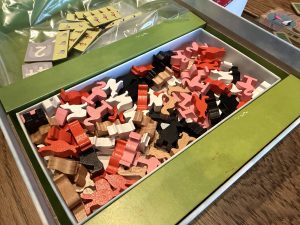
Filling enclosures with animals isn’t just for theme, it triggers breeding events, which can quickly multiply your animals and help you complete spaces faster. It also rewards you with smaller filler pieces, which are perfect for patching up those frustrating gaps in your layout. Because of this, you’re constantly weighing when to expand versus when to invest in animals. Timing becomes the whole game: you want to place tiles efficiently, but also hit those key moments when breeding gives you the biggest advantage.
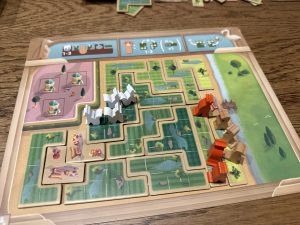
There’s no scoring system in the traditional sense. Instead, the goal is to be the first player to completely fill their zoo board. That turns the game into a race, where efficiency, planning ahead, and minimizing wasted space are critical. Every turn feels like a small optimization puzzle, and small mistakes can cost you later.
Despite my description, it does feel like a relaxing puzzle and a light strategy game. The combination of spatial planning, animal management, and well timed breeding keeps the experience engaging from start to finish.
Verdict: It is easy to learn, visually satisfying, but with just enough decision making around timing and placement to keep it engaging.
Reviewed on 02/05/2026, updated on 04/19/2026
Score Breakdown
| Category | Description | Score (1–10) |
|---|---|---|
| 1. Aesthetics & Components | Visual design, artwork, tactile quality, and overall presentation. | 8 |
| 2. Rules Clarity & Accessibility | Ease of learning, clarity of rulebook, setup time, and iconography. | 10 |
| 3. Strategic Depth | Amount of meaningful decision-making and long-term planning. | 5 |
| 4. Luck vs. Skill Balance | How fairly chance and skill coexist. | 8 |
| 5. Player Interaction | Engagement and social dynamics between players. | 5 |
| 6. Pacing & Downtime | Flow, engagement, and smoothness of play. | 9 |
| 7. Replayability | Longevity, variability, and continued appeal. | 6.5 |
| 8. Theme Integration | How well the mechanics and story fit the theme. | 9 |
| 9. Enjoyment & Emotional Impact | Pure fun factor—excitement, tension, satisfaction. | 7 |
| 10. Innovation & Uniqueness | Creativity, originality, and distinctiveness from other games. | 6 |
| Overall Mean Score | 7.35 / 10 | |